

Skip to content
  • Solutions

    Solutions

    E-commerce market data & insights

    Accurate and granular insights backed by millions of data points collected every week

    Tradewinds

    Cube's strategic e-commerce market data offering for investors, internet platforms, and corporates.
  • Technology

    Technology

    Why Cube?

    We achieve best-in-class data accuracy and granularity through statistical and machine learning models

    Data Collection

    Multiple data sources ensure accurate, high-quality insights by triangulating proprietary and external data.

    Data Security

    At Cube, safeguarding data integrity and confidentiality is our foremost priority.

    Product Tagging

    We have the most comprehensive classification system in the industry across platforms and countries
  • Insights

    Insights

    Cube Pulse - Articles

    Stay updated with our latest research, insights, and perspectives on hot topics in e-commerce

    Research reports

    Free to download research reports to help you understand the e-commerce landscape better

    E-commerce Glossary

    We've put all e-commerce terminology in one place so you can find the answers you are searching for

    E-commerce Platform Take-rate tracker

    This tracker provides up-to-date insights into current e-commerce platform take-rates by country and product category, offering a clear view of the marketplace dynamics.

    E-commerce Category Tree

    Cube's coverage follows a unified, standardized category tree across countries and platforms.

    OSCX index

    A benchmark of e-commerce seller sentiment across Southeast Asia and other key Shopee markets
  • Community

    Community

    Shopper Panel

    Join our Online Shopper Panel and answer paid surveys about your habits and opinions about e-commerce

    Seller Panel

    Join the Cube Data Partnership to help us build better insights for the ecosystem
  • Company

    Company

    About us

    Learn more about our mission, credentials, and how we work.

    Our Team

    We recruit great people and help them become better. Collaborate, Innovate, and Lead with Data at Cube

    Careers

    If you love working with data, hold a high bar for quality, and enjoy working with super-smart and collaborative people, Cube is the perfect place for you.

    Contact us

    Send us a question, ask to be contacted, or book a meeting with our expert team today

    Cube in the news

    Cube is frequently quoted in news stories about e-commerce. See our latest coverage here
Contact us
  • Solution
    • E-commerce market data & insights
    • Tradewinds – Strategic Market Data for Southeast Asia E-Commerce
  • Technology
    • Why Cube Asia?
    • Data Collection
    • Data Security
    • Product Tagging
  • Insights
    • Cube Pulse – Articles
    • Research Reports
    • E-Commerce Glossary
    • Shopee Take-Rate Tracker
    • E-commerce Category Tree
    • OSCX Index
  • Community
    • Shopper Panel
    • Seller Panel
  • Company
    • About us
    • Our Team
    • Career
    • Cube in the news
  • Contact us

Alibaba’s Impact on Southeast Asian SMEs: Will The E-Commerce Giant Be Able to Grow Market Share?

  • By Affifa
  • September 27, 2025
Link
Request
sample

Alibaba

Source: Alizila 

Southeast Asia’s e-commerce market could reach $325 billion by 2028, and small- and medium-sized enterprises (SMEs) have been crucial to this growth. E-commerce provided a space for SME owners that has only grown since the pandemic, and in 2022, SMEs contributed almost 45% of the region’s nominal GDP.

The key players in the region have historically been Shopee, Lazada, and Tokopedia, and newcomers like TikTok Shop continue to shape the landscape. 

However, in this article, we will dive into how Alibaba fits into the overall e-commerce market share in Southeast Asia, and how they are changing the game for e-commerce businesses. 

What is Alibaba?

Alibaba was founded in 1999 as a B2B seller and has since become one of the world’s largest and well-known e-commerce marketplaces by leveraging the internet’s power to create the e-commerce giant that we know today. 
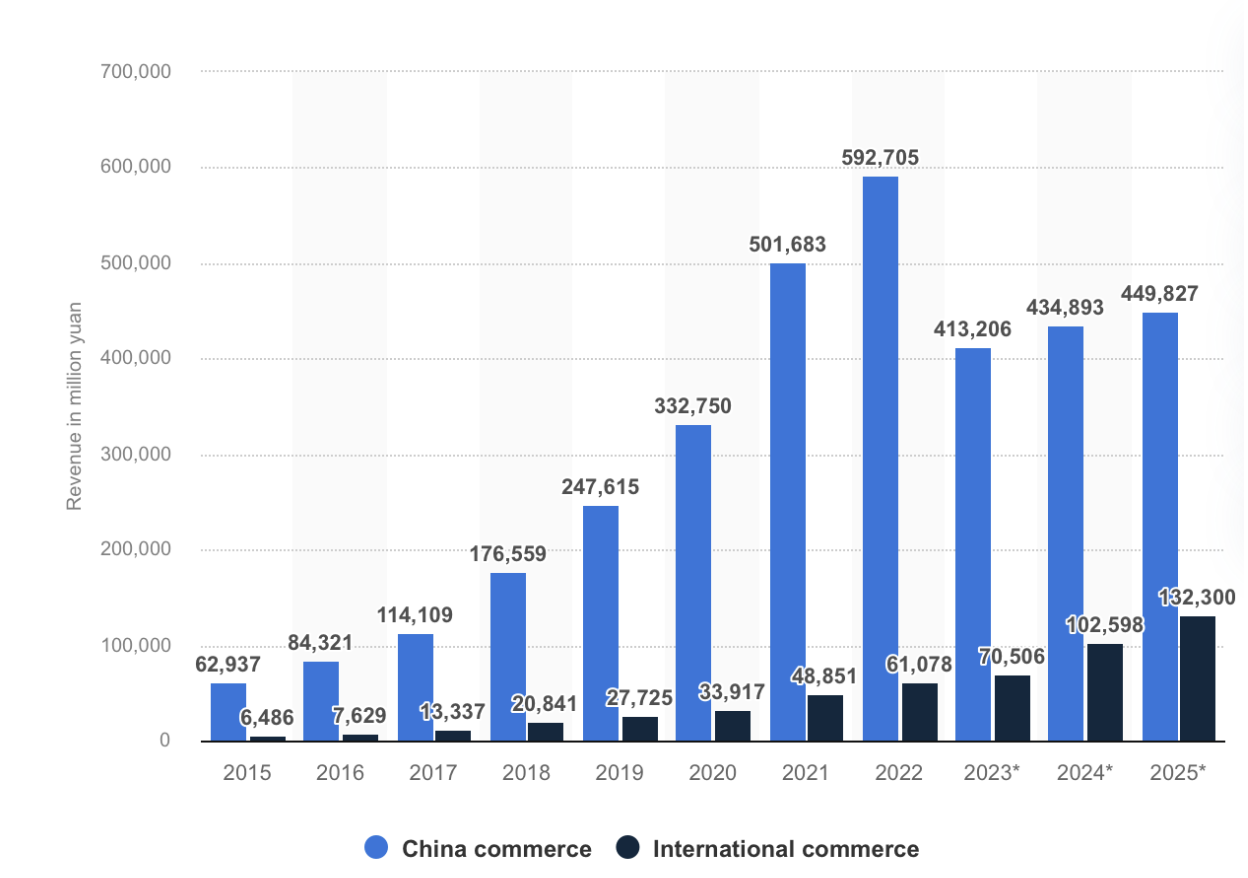
Source: Statista 

Today, Alibaba is not just only a B2B seller, but a platform where B2C and C2C businesses can conduct their sales. The company is behind Taobao and Tmall (both e-commerce platforms catering to Chinese consumers) and even entertainment content. However, while Alibaba may have once been a pioneer in the space, it has been losing market share to PDD (the holding company of Temu) and Douyin. 

Alibaba in Southeast Asia 

Alibaba has also a large stake in Lazada, which is one of the leading e-commerce platforms in the region, with a specific focus on Indonesia, Malaysia, the Philippines, Singapore, Thailand and Vietnam.

The company has been diversifying its product in Southeast Asia and continues to build its business in the world’s fifth largest economy. 

In the past few years, Alibaba is expanding its AI infrastructure in Southeast Asia by building data centers in Malaysia, the Philippines, and an AI hub in Singapore. This investment is slated to invest $53 billion in AI, and train 100,000 workers on its platform. This marks Southeast Asia as a planned hub for AI investment—and to keep up with rising demand for the services. 

This is a continuation of its investment in the region. In 2016, Alibaba purchased 54% equity interest in Lazada—equivalent to around $1 billion dollars—allowing local and global merchants to conduct their business on the platform. Importantly, this opened up a brand new market for local and global merchants. 

SMEs Are Vital to the Southeast Asian E-Commerce Economy

First, let’s discuss what classifies a business as a small- to medium-sized enterprise, also known as an SME.

According to Cube Asia, a SME is used to categorize businesses which have relatively smaller levels of revenue, workforce, and assets compared to larger corporations.

This definition of a SME can vary based on country or region. For example, in Singapore, a business has to have an annual turnover of less than $100 million, have less than 200 employees, and a balance sheet that does not exceed a certain amount to be considered a SME. 

Southeast Asian SMEs

Source: Arthur Little

SMEs are vital to the economy, in both SEA and around the globe. In fact, the Organization for Economic Cooperation and Development (OECD) estimated that SMEs made up around 40% of local GDP and 70% of local employment. 

How Will Alibaba’s Expansion Affect Small- and Medium-Sized Enterprises in the Region?

Alibaba’s impact on small to medium sized business enterprises can perhaps be most felt in the platforms’ ability to connect buyers and sellers. 

For example, in Malaysia, Alibaba has created a platform specifically for sellers in that country to reach a global audience. This platform, called Halal Pavilion, is a dedicated section of Alibaba’s e-commerce site that aims to connect SMEs selling certified halal products to a global market. 

Alibaba has also created programs to support the growth of SMEs in Singapore. The company works with the country’s Infocomm Media Development Authority (IMDA) and EnterpriseSG to provide more opportunities for SMEs to export their products globally. One of these opportunities includes a webpage dedicated to Singapore SMEs, showcasing products on Alibaba’s homepage. 

What Does Alibaba’s Growth Mean for E-Commerce in Southeast Asia?

With all e-commerce platforms combined, Southeast Asia’s total e-commerce gross merchandise value (GMV) totaled $145.2B, representing 12.8 percent market penetration. 

While Alibaba has its sights set on the Southeast Asian region, its biggest market remains China—accounting for almost 90% of e-commerce revenues there. 

Lazada claims that by 2030 they aim to serve 300 million customers, and backed by Alibaba’s technology infrastructure, they are on the right path. 

Ready to unlock new opportunities?

Schedule a meeting with our expert team to gain deeper insights and explore how our data can drive your success.

Book a meeting

Related Articles

E-commerce

September 4, 2025

The Rollercoaster Ride of Southeast Asia’s E-Commerce Growth: What’s Around the Corner?

Data Analysis, Indonesia

May 5, 2025

Unmasking 'Fake Sales': A Hidden Challenge In Indonesia’s E-Commerce Market

TikTok Shop

February 24, 2025

The best is yet to come: TikTok Shop’s pivotal 2024, and what’s in store for 2025

Become part of our e-commerce community

Join 2,000+ other leaders and experts to stay informed about the latest news, insights, and updates

  • info@cube.asia
  • Cube

Solutions

  • E-commerce market data & insights
  • Tradewinds

Community

  • Shopper Panel
  • Seller Panel

Technology

  • Why Cube?
  • Data Collection
  • Data Security
  • Product Tagging

Insights

  • Cube Pulse - Articles
  • Research reports
  • E-Commerce Glossary
  • Take-rate tracker
  • E-commerce Category Tree
  • OSCX Index

Company

  • About us
  • Our Team
  • Careers
  • Contact us
  • Cube in the news

Copyright 2025 Cube. All Rights Reserved.

Request sample data

Please enter the details below to request sample data

Your message has been successfully sent

We appreciate that you’ve taken the time to write us. We’ll get back to you very soon. Please come back and see us often.