
Since its inception, e-commerce has often been labeled as the ultimate convenience. Convenience can mean more than just a store being there at the right time with the right products, it can mean a seamless checkout experience, a quick delivery, or the right mix of products.
Consumers now have the option to browse, purchase, and have delivered virtually any product imaginable. Currently, the region’s market is dominated by e-commerce powerhouses like Lazada, Shopee, Tokopedia, and TikTok Shop.

In today’s market, the balance between price and convenience is crucial. And it is clear that the consumer is price conscious–now more than ever–meaning that e-commerce retailers that can provide a convenient service and product at the right price have a huge leg up in the highly competitive Southeast Asian market.
In the past year, 39% of Southeast Asian consumers have cut back on their spending. Burdened by an uncertain broader economic situation and the rising cost of living, 69% of consumers in the region are focusing on essential purchases, and 55% are attempting to reduce spending on non-essential items.
In order to appeal to consumers who may be feeling a strain on their wallets, e-commerce retailers must ensure that consumers feel that the price is right.
Read on to learn about what today’s consumers value in terms of a convenient e-commerce shopping experience.
Convenience in Online Shopping
Southeast Asia has one of the fastest-growing e-commerce markets across the world.
In 2024, about 52% of Southeast Asian survey respondents indicated they preferred shopping online. More and more consumers continue to log into e-commerce shopping giants like Lazada, which is one of the largest online marketplaces in the region, with over 100 million active users. One study found that, in Indonesia, 67% of order volume came from mobile devices.
 Source: Statista
E-commerce allows shoppers to pick up their phone, laptop, or tablet and immediately start their shopping journey. While 38% of the regions consumers prefer to shop in the store, there is still opportunity for e-commerce businesses to capture this consumer.
What is considered convenient in Southeast Asian e-commerce?
About 55% of consumers reported they were likely to spend more on convenient e-commerce platforms. However, convenience often means different things to different people, so it would be nearly impossible to say what each consumer is looking for in terms of their shopping experience.
E-commerce businesses must know their consumer base well in order to provide them with the most convenient transaction, which could be a wide and personalized product selection, a quick delivery, or the cheapest price.
Product Selection
One of the largest advantages of an online store is the wide variety of product selection. Consumers can browse hundreds of options in a matter of minutes, which would not be feasible at a traditional brick-and-mortar store, and can find exactly what they are looking for.
For those consumers on a time-crunch or trying to cut back on their expenses, online shopping allows them to browse for the option that best meets their goal.
To make the shopping experience more convenient, many e-commerce retailers have started integrating AI in order to personalize the shopping experience. Many retailers use predictive analytics and other AI initiatives to enhance the user experience. They ensure that customers see products they have interest on through ads, marketing, and search recommendations.
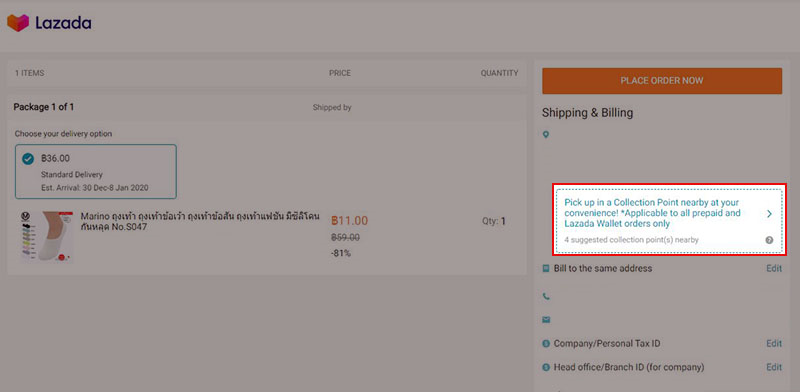
Source: Lazada
Many e-commerce businesses have combined aspects of both e-commerce and in-store shopping. Lazada, for example, offers a “click-and-collect” option where the customer can pick up their online purchase in person, and also satisfy the desire to browse the aisles of a physical store.
Fast Delivery
Logistics and shipping are quickly evolving, but cost was also a factor in delivery.
Southeast Asian consumers have come to expect same-day delivery from their e-commerce shopping platform. Over half of shoppers expect their purchase to be delivered in just two days.
Major businesses like Lazada, Shopee, and TikTok Shop have upped their delivery speed. Shopee, for example, has integrated an estimated delivery time tool that allows consumers to see exactly when their package will arrive. This tool is both convenient and helpful, promoting trust in the platform and, hopefully, will encourage the consumer to shop there again.
In 2024, the cost of delivery was at the top of the list of consumer priorities, above the need for a quick delivery. This is just one of the ways where the cost could potentially outweigh a convenience factor for consumers.
Convenience vs Price
As we mentioned earlier, the Southeast Asian consumer is likely feeling the pressure of an uncertain economic climate. This is causing many to cut down on non-essential items or to reevaluate their shopping habits.
In order to appeal to these consumers, businesses have successfully tried flash sales that customers can take advantage of. These sales promote deeply-discounted items for a limited amount of time on specific days. By promoting large-scale sales that would be difficult for physical retail stores to emulate, businesses can attract consumers looking for a convenient way to shop sales.
These sales could be another way to introduce price-sensitive customers to new products: 67% of global consumers are likely to switch to a new brand because it has a lower price, according to NIQ.
The Future of Convenience in Southeast Asia
The Southeast Asian e-commerce market is one of the fastest growing markets across the globe, and the internet penetration rate continues to grow. By 2027, around 88% of the region’s population is expected to engage in e-commerce and to flood the market with an extra 402 million users.
Businesses can set themselves up for continued success by understanding what the next generation of internet users and potential e-commerce shoppers will value in terms of convenience.