

The Modern Parenting Consumer: How Mom & Baby E-commerce is Shifting in Indonesia in 2026
Indonesia’s Mother & Baby e-commerce category grew 36% year on year in Q1 2026 to roughly 20 trillion IDR across the three platforms Cube tracks in Tradewinds: Shopee, TikTok Shop, and Lazada. Shopee still commands the category with a 69% share, but TikTok Shop is the fastest-rising force, and Baby personal care is where the shift is most visible. Here is what the data says, and what brands should do about it.
Key takeaways
The category is compounding fast. Indonesia’s Mother & Baby e-commerce reached about 20 trillion IDR in Q1 2026, up 36% year on year, according to Cube Tradewinds estimates.
Shopee leads, TikTok Shop climbs. Shopee held a 69% share of the category in Q1 2026. TikTok Shop more than doubled its share from 10% in 2023 to 22% in 2025, then accelerated to 27% in Q1 2026, the fastest share gain of any platform.
The two platforms sell different baskets. On TikTok Shop, Baby personal care makes up 41% of the top products, more than double Shopee’s 19%. Shopee over-indexes on planned, functional purchases like food, supplements, and diapers.
Local challengers have caught up. Post-TikTok brands such as Moell, Gently, Purela, and Expert Care now rival global incumbents like Johnson’s, Mustela, and Cussons in Baby personal care.
Winning is a formula. Cube’s online growth algorithm is Product multiplied by Price and Promotion multiplied by Activation. All three have to fire together.
How big is Indonesia's Mother & Baby e-commerce market in 2026?
Indonesia’s Mother & Baby category reached approximately 20 trillion IDR in Q1 2026, a 36% jump on the same quarter a year earlier, based on Cube Tradewinds estimations. That growth sits well above the wider regional pace. Cube’s data shows Southeast Asia is 16 years into its e-commerce build-out, with about a quarter of total consumer spending now online and the market compounding at roughly 13% a year. Mother & Baby is running ahead of that curve.
The growth is not evenly shared. Most of the Q1 2026 expansion was driven by TikTok Shop, which pulled category momentum toward its discovery-led format while the two established players held or lost ground.
Which platform leads Mother & Baby in Indonesia?
Shopee remains the commanding leader, holding a 69% share of the Indonesian Mother & Baby category in Q1 2026. Its strength sits in the parts of the aisle parents plan and repeat-buy: food and supplements, and diapers.
TikTok Shop is the story underneath the leadership. Its share moved from 10% in 2023 to 22% in 2025, then to 27% in Q1 2026, the fastest gain among all platforms. Lazada, meanwhile, continued to lose ground in the category.
The gap between Shopee and TikTok Shop is still wide, but it is closing from one direction only. For brands, that means Shopee is where the volume base lives and TikTok Shop is where the incremental growth is being won.
What sells on TikTok Shop versus Shopee in the baby aisle?
The two platforms attract different shopping behaviour, and the product mix makes that obvious.
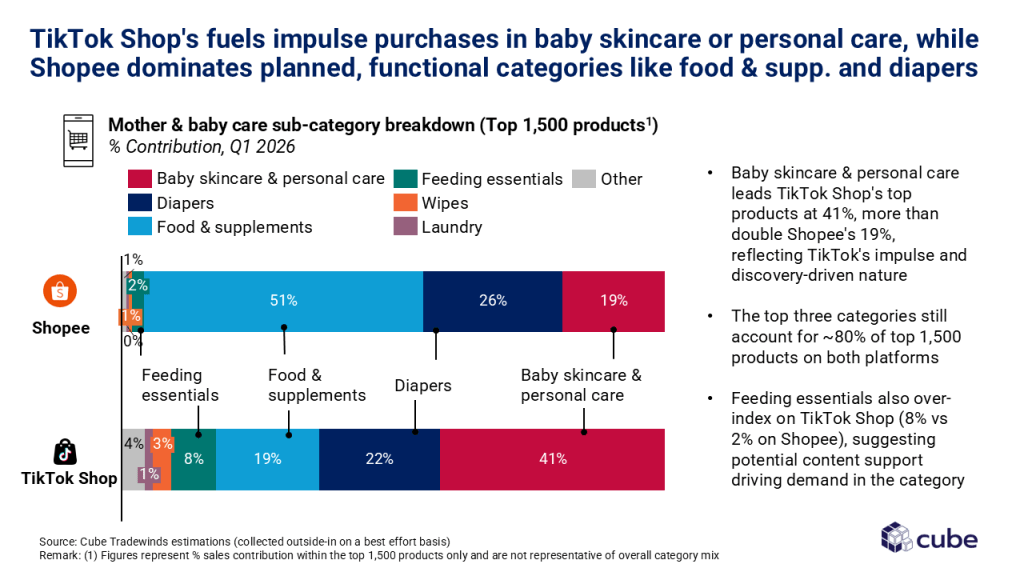
On TikTok Shop, Baby personal care leads the top products at 41%, more than double Shopee’s 19%. Feeding essentials also over-index on TikTok Shop at 8%, versus 2% on Shopee, which points to content and creator activity pulling demand into categories that usually rely on planning. This is the signature of a discovery and impulse driven channel: the feed creates the need.
On Shopee, the mix skews toward planned and functional buying. Food and supplements and diapers dominate the top products, reflecting a platform shoppers reach for when they already know what they want and are buying on price, reliability, and repeat convenience.
On both platforms, the top three sub-categories account for around 80% of the top 1,500 products, and they are the same three: Baby personal care, diapers, and food and supplements. What differs is the weighting. Shopee leans to diapers and food and supplements, TikTok Shop to Baby personal care.
A note on scope: these product mix and sub-category figures cover only the top 1,500 products tracked, so the category may be underrepresented.
Have local brands caught up with the global incumbents?
Yes, and faster than most category leaders expected. In Baby personal care, local post-TikTok challenger brands now sit alongside long-established global names.
Baby personal care: local challengers such as Moell, Gently, Purela, and Expert Care now rival incumbents like Johnson’s, Mustela, Cussons, and Zwitsal. On this sub-category, TikTok Shop commands a higher average selling price, around 70,000 IDR versus about 50,000 IDR on Shopee. Community building, educational content, and doctor-backed positioning are pushing premiumisation as parents look for clinically credible, niche products.
Feeding essentials: global incumbents like Pigeon and Avent still lead, but local challengers including Sakumini, Mom Uung, and iBebe have gained traction, especially on TikTok Shop. Here the price story inverts: TikTok Shop skews more affordable, around 60,000 IDR versus about 70,000 IDR on Shopee, driven by price-competitive local players.
The takeaway for brand teams: the moat is no longer heritage. In personal care, credibility and content win. In feeding, price and range win. Both are being contested by nimble local brands that were built for TikTok from day one.
Why is video commerce the engine behind these shifts?
Because it has moved from novelty to infrastructure. Video commerce, including livestreams, now drives about 25% of Southeast Asia’s e-commerce GMV, up roughly 20 percentage points since 2022 (Cube estimations on e-Conomy SEA data). Health and baby products account for 7% of that video commerce GMV. That share is still small next to fashion and accessories at 27% and beauty and personal care at 21%, but given the momentum in the category, there is room for it to grow.
That is the mechanism behind the baby personal care surge on TikTok Shop. When the format rewards demonstration, education, and creator trust, the categories that benefit most are the ones a parent can be persuaded to try, not just the ones they already planned to restock.
What does it take to win? Cube's online growth algorithm in e-commerce
Cube frames e-commerce campaign success as the combination of three factors: Product, Price and Promotion, and Activation. All three must fire together, and weakness in any one limits overall campaign performance.
Weakness in any single factor caps the whole campaign, because the three reinforce one another rather than stacking.
Product: the right offering. Hero SKUs aligned to search trends, the right assortment width across entry, core, and premium tiers, strong ratings and reviews (4.5 stars and up builds conversion trust), and stock readiness to absorb sales spikes.
Price and Promotion: a compelling value proposition. Competitive price indexing versus rivals, exclusive live pricing and urgency, flash deals, bundle mechanics such as buy-more-save-more, and platform vouchers with co-funded coupons.
Activation: the traffic and conversion engine. Livestreaming, short video content, influencer and creator media with commissions and sampling, and ROAS-optimised paid media.
Two TikTok Shop playbooks that are working
Cube’s tracking surfaced two distinct, repeatable models in the baby’s personal care and feeding essentials, each tuned to a different shopper.
Moell: premium technology, accessible price and sells products from baby skincare, bath & hygiene. Moell pairs a premium microbiome-technology positioning with attractive pricing. Its activation leans on long-form, always-on livestreams (around 5 hours, two to three times a day) that build community and drive sustained daily sales, supported by a high volume of educational content. Affiliate commissions run in the 5% to 10% range, with four to five videos a day. This is the premiumisation play: credibility and consistency compound into trust.
Sakumini: affordable range, event-driven bursts and sells diversified products from baby, ranging from feeding products (breast pump, bottles, container) and other accessories and travel/daily essentials. Sakumini competes on an affordable, diversified range built for price-sensitive mothers. Its streams are shorter and event-driven (two to three hours) timed around payday, weekends, and flash sale moments, with entertainment-led content carrying educational depth. Bundles run up to 50% off, and generous commissions (5% on single items, 10% on bundles) pull in top creators. This is the volume and value play: intensity around the moments that convert.
Different starting points, same discipline. Both brands treat content volume, livestream cadence, and creator economics as core operating levers, not marketing extras.
The bottom line
Indonesia’s Mom & Baby category is growing fast, but the growth is not landing evenly. Shopee still owns the planned, functional basket, while TikTok Shop’s discovery-driven format is pulling Baby personal care, and increasingly feeding essentials, into its orbit. The brands winning that shift are not the ones with the longest heritage. They are the ones treating content, livestreams, and creator economics as core operating levers, whether that is Moell’s always-on premium play or Sakumini’s event-driven value play. For any brand in this category, the question for 2026 is no longer whether to be on TikTok Shop. It is which of those two models fits.
Frequently asked questions
How big is Indonesia's Mother & Baby e-commerce market in 2026?
It reached about 20 trillion IDR in Q1 2026, up 36% year on year, according to Cube Tradewinds estimates.
Which platform leads Mother & Baby in Indonesia?
Shopee, with a 69% category share in Q1 2026. TikTok Shop is second and growing fastest, reaching 27% share in Q1 2026 from 10% in 2023.
What sells best on TikTok Shop in the baby aisle?
Baby personal care, which makes up 41% of TikTok Shop’s top products, more than double Shopee’s 19%. Feeding essentials also over-index on TikTok Shop.
Are local Indonesian baby brands beating global incumbents?
In Baby personal care, local post-TikTok brands like Moell and Gently now rival global names such as Johnson’s and Mustela. In feeding essentials, global incumbents Pigeon and Avent still lead, though local challengers are gaining on TikTok Shop.
What is Cube's e-commerce growth formula?
E-commerce campaign success equals the combination of three factors: Product, Price and Promotion, and Activation. All three must fire together, and weakness in any one limits overall campaign performance.
Source: Cube Tradewinds & Astro category tracking dataset. All figures are estimates covering physical goods GMV on the mentioned platforms of the category and do not represent total e-commerce in Indonesia.