

Beauty Beyond the Marketplace: How Indonesia's Beauty & Personal Care Commerce Is Shifting in 2026
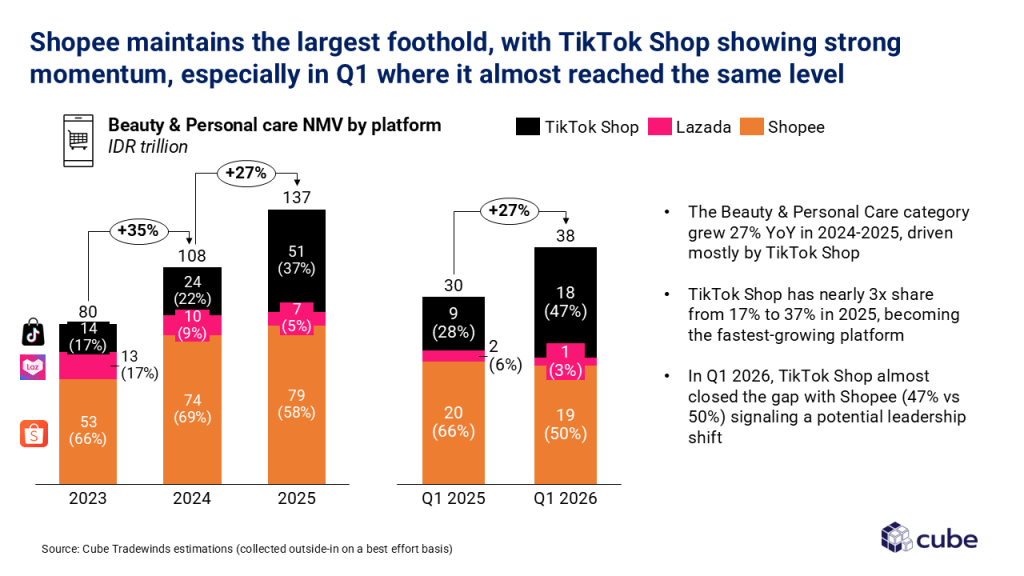
Indonesia’s Beauty & Personal Care e-commerce category grew 27% year on year in 2025 to roughly 137 trillion IDR across the three platforms Cube tracks in Tradewinds: Shopee, TikTok Shop, and Lazada. Shopee still holds the largest share, but TikTok Shop has nearly caught up, closing to 47% against Shopee’s 50% in Q1 2026. Here is what the data says about the platforms, the brands, and the tactics defining the category.
Key takeaways
- The category is growing fast, and TikTok Shop is driving it. Beauty & Personal Care e-commerce across the three platforms Cube tracks reached about 137 trillion IDR in 2025, up 27% year on year, with most of the growth coming from TikTok Shop (Cube Tradewinds estimates).
- A leadership shift is in sight. TikTok Shop nearly tripled its share of the category, from 17% in 2023 to 37% in 2025. In Q1 2026 it reached 47% against Shopee’s 50%, close enough to signal a possible change at the top.
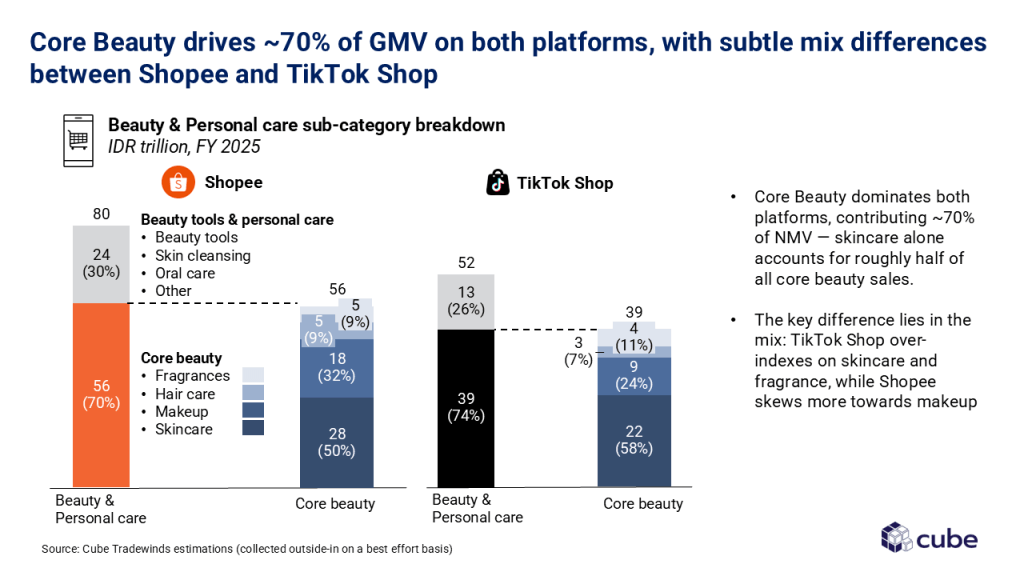
- Core beauty rules, but the mix differs. Core beauty is around 70% of category sales on both platforms, and skincare alone is roughly half of that. TikTok Shop over-indexes on skincare and fragrance, while Shopee skews more toward makeup.
- Skincare is a contested field. Skintific and Glad2Glow still lead, but derma brands, K-beauty, and rising local challengers are reshaping the top ranks.
- Video commerce is the engine. Video commerce, including livestreams, now drives about 25% of Southeast Asia’s e-commerce GMV, and Beauty & Personal Care is the second-largest category within it at 21%.
- Bundles do the heavy lifting. Not all bundles perform the same. Volume bundles drive quick sales, sets extend range, and full-routine regime bundles drive premiumisation.
How big is Indonesia's Beauty & Personal Care e-commerce market in 2026?
Beauty & Personal Care e-commerce across the three platforms Cube tracks in Tradewinds reached roughly 137 trillion IDR in 2025, a 27% rise year on year, based on Cube Tradewinds estimations. Most of that growth was driven by TikTok Shop.
The category sits inside a much larger regional story. Cube’s data shows Southeast Asia is 16 years into its e-commerce build-out, with about a quarter of total consumer spending now online and the market compounding at roughly 13% a year. Beauty is one of the front-runner categories in that shift. In Vietnam, for example, beauty has already crossed 50% online share, a marker of how far ahead of the pack the category can run.
To be clear on scope: these figures cover e-commerce on the three platforms Cube tracks, not the total Beauty & Personal Care market including offline retail.
Which platform leads Beauty & Personal Care in Indonesia?
Shopee still holds the largest foothold, but its lead is narrowing between 2024 and 2025
TikTok Shop nearly tripled its share of the category, moving from 17% in 2023 to 37% in 2025, which made it the fastest-growing platform in the category. The momentum carried into early 2026. In Q1 2026, TikTok Shop reached 47% of category sales against Shopee’s 50%, almost closing the gap and signalling a potential leadership shift. Lazada, meanwhile, held only a small share of the category.
This platform-level picture is reflected in each platform’s own mix. Across all categories in Indonesia, Beauty & Personal Care made up around 26% of TikTok Shop’s total GMV in Q1 2026, compared with roughly 13% on Shopee (Cube Tradewinds). In other words, beauty is a far heavier part of what sells on TikTok Shop, which is exactly why the platform has been able to scale the category so fast.
What is inside the category? Skincare, makeup, and the mix that separates the platforms
Core beauty, meaning skincare, makeup, hair care, and fragrances, accounts for around 70% of Beauty & Personal Care sales on both Shopee and TikTok Shop (Cube Tradewinds, FY 2025). Skincare alone is roughly half of all core beauty sales, making it the single most important sub-category on either platform.
The interesting part is where the two platforms diverge. TikTok Shop over-indexes on skincare and fragrance, the categories that lend themselves to demonstration, routine-building, and creator storytelling. Shopee skews more toward makeup. The remaining share, around 30% on each platform, sits in beauty tools and personal care.
For brands, that mix difference is a planning input, not a footnote. If your strength is skincare or fragrance, TikTok Shop is where the category is being pulled. If it is makeup, Shopee still carries relatively more of that basket.
Which brands are winning skincare in Indonesia?
As of Q1 2026, Skintific and Glad2Glow continue to lead the skincare rankings on both platforms, though the field around them is being reshaped by three forces, according to Cube Category Tracking (Q1 2026): derma brands such as La Roche-Posay and Cetaphil, K-beauty entrants such as Skin1004, and rising local challengers such as Wardah and Facetology.
Price is where the two platforms part ways. The average skincare selling price on Shopee sits at around 100,000 IDR, versus about 70,000 IDR on TikTok Shop. TikTok Shop’s lower average price reflects its promotion-heavy, discovery-led format, where bundles and live pricing pull the effective price down. This is the more typical pattern for the platform, and it is worth noting because it shapes how brands should price and promote on each channel.
A note on scope: brand rankings reflect Cube Category Tracking, which covers total brand sales across official and reseller shops, rather than a full census of every seller in the category.
Why is video commerce the growth engine for beauty?
Because it has moved from novelty to infrastructure. Video commerce, including livestreams, now drives about 25% of Southeast Asia’s e-commerce GMV, up roughly 20 percentage points since 2022 (Cube estimations on e-Conomy SEA data).
Beauty is one of the biggest beneficiaries. Within video commerce, Beauty & Personal Care is the second-largest category at 21% of video commerce GMV, behind onlyashion and accessories at 27% and ahead of phone and electronics at 12%. These are all-shopper regional figures, but the ranking makes the point plainly: when the format rewards demonstration, routine-building, and creator trust, beauty is one of the categories that gains the most.
That is the mechanism behind TikTok Shop’s rise in the category. The platform’s format and beauty’s product characteristics are unusually well matched.
How do brands actually win? Cube's online growth framework
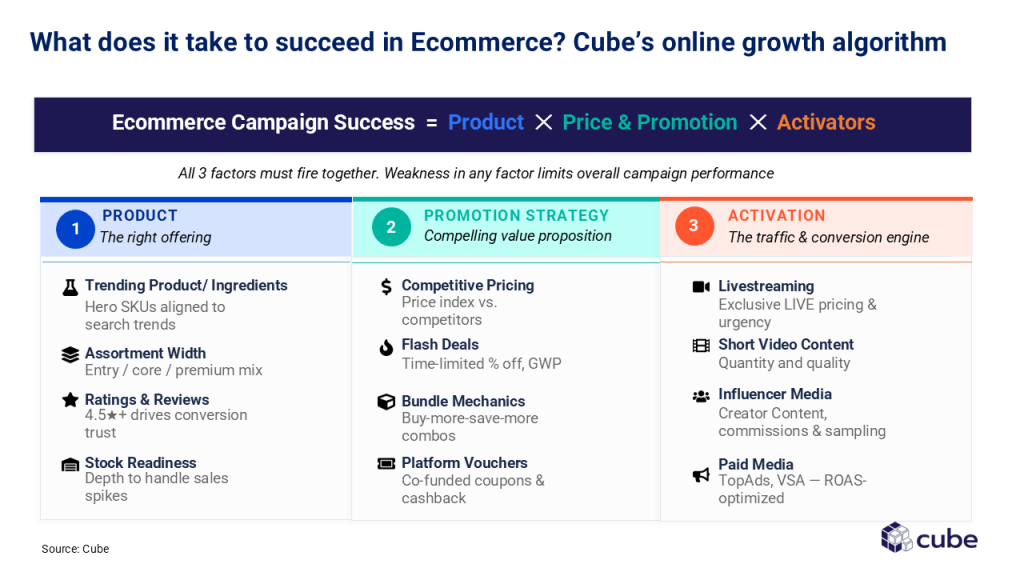
Cube frames e-commerce success as three factors that have to work together, not as a single lever:
E-commerce campaign success = Product, Price and Promotion, and Activation.
All three must fire together, and weakness in any one limits overall campaign performance.
Product: the right offering. Hero SKUs aligned to search trends, trending products and ingredients, the right assortment width across entry, core, and premium tiers, strong ratings and reviews (4.5 stars and up builds conversion trust), and stock readiness to absorb sales spikes.
Price and Promotion: a compelling value proposition. Competitive price indexing versus rivals, exclusive live pricing and urgency, flash deals, bundle mechanics, and platform vouchers with co-funded coupons and cashback.
Activation: the traffic and conversion engine. Livestreaming, short video content, influencer and creator media with commissions and sampling, and ROAS-optimised paid media.
Not all bundles are created equal
Promotion strategy is where a lot of beauty campaigns are won or lost, and Cube’s tracking shows that bundle type matters. Three archetypes are gaining commercial traction, each with different benefits and different costs.
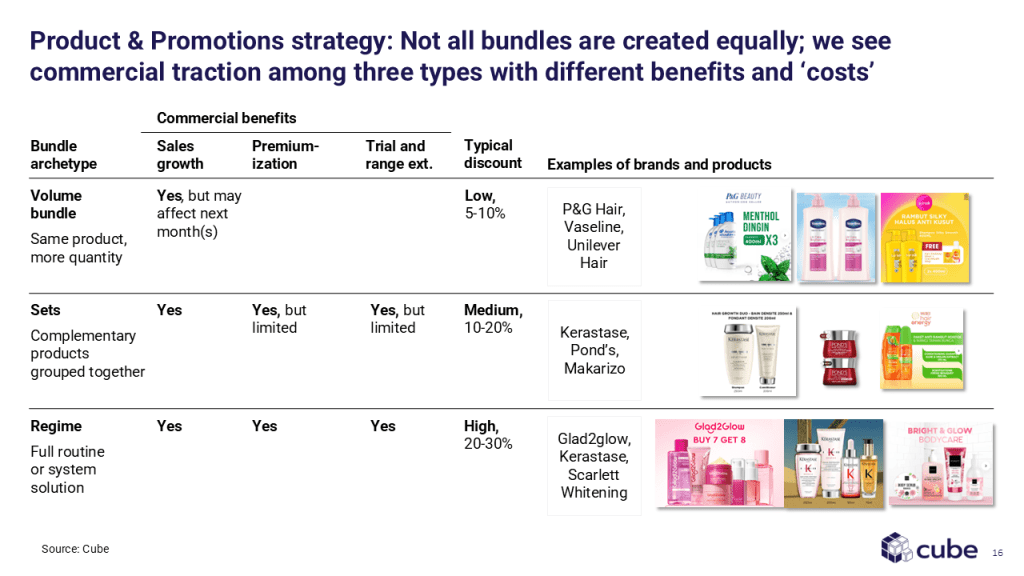
The takeaway is to match the bundle to the goal. If you want fast volume, a quantity bundle works but may borrow from next month. If you want to lift average order value and introduce shoppers to a fuller routine, a regime bundle carries a deeper discount but does more strategic work.
Case study: the Hero Bundle Flywheel on TikTok Shop
Cube’s tracking of the 12.12 campaign surfaced a repeatable model that Cube calls the Hero Bundle Flywheel, run by Glad2Glow and Kerastase on TikTok Shop. The steps are consistent: anchor the bundle around a hero product, offer attractive incremental value (both brands ran discounts of 20% or more versus buying items individually), amplify through the brand’s own videos and livestreams, then extend reach through influencers, from a handful of mentions to more than 30.
The results were significant. Across the two brands, the bundles landed top-two best-seller rankings during 12.12, contributed in the region of 10% to 15% of sales, and drove large average price lifts, ranging from roughly 120% to 300% versus individual purchases. The pattern is clear: a hero-anchored bundle, amplified through the brand’s own content and then influencers, compounds into ranking, volume, and higher order value at once.
Frequently asked questions
How big is Indonesia's Beauty & Personal Care e-commerce market in 2026?
Beauty & Personal Care e-commerce across the three platforms Cube tracks in Tradewinds, Shopee, TikTok Shop, and Lazada, reached about 137 trillion IDR in 2025, up 27% year on year, according to Cube Tradewinds estimates.
Which platform leads Beauty & Personal Care in Indonesia?
Shopee, but only just. In Q1 2026 Shopee held 50% of category sales while TikTok Shop reached 47%, after TikTok Shop nearly tripled its share from 17% in 2023 to 37% in 2025.
Which skincare brands are winning in Indonesia?
Skintific and Glad2Glow lead the skincare rankings on both platforms, with derma brands, K-beauty entrants, and local challengers reshaping the ranks below them.
Is skincare cheaper on TikTok Shop or Shopee?
The average skincare selling price is lower on TikTok Shop, at around 70,000 IDR, versus about 100,000 IDR on Shopee, reflecting TikTok Shop’s promotion-led format.
What is Cube's e-commerce growth framework?
Cube frames success as three factors working together: Product, Price and Promotion, and Activation. All three must fire together, because weakness in any one limits overall performance.
Data source: Cube Tradewinds and Cube Category Tracking, Q1 2026, with regional video commerce figures based on the e-Conomy SEA report – Cube estimations. Figures are estimates covering e-commerce on the three platforms Cube tracks, Shopee, TikTok Shop, and Lazada, and do not represent the total Beauty & Personal Care market including offline retail. Cube is the leading market data and insights provider for e-commerce in Southeast Asia and beyond.