AI is the defining topic of 2026 in almost every industry, and eCommerce is no exception. From general-purpose assistants like ChatGPT and Gemini to purpose-built shopping assistants on eCommerce platforms, AI can now support almost every step of the purchase journey, and some tools can already complete purchases on a shopper’s behalf.
That has big implications for savvy shopping. Our 2026 eCommerce Savvy Shopper Report with Lazada found that what sets Savvy Shoppers apart is the extra work they put in across four dimensions: Verification, Value Optimisation, Confidence & Protection and Digital Fluency. AI could take much of that effort off shoppers’ hands, for example by researching sellers beyond the platform, scouring social media and forums for honest reviews, comparing prices across platforms or digging up a seller’s return terms. In short, AI could help many more shoppers shop the way Savvy Shoppers already do. But are shoppers ready and comfortable handing over that work to AI?
To find out, we drew on the survey behind the report, which asked 6,000 shoppers across Indonesia, Malaysia, the Philippines, Singapore, Thailand and Vietnam how they research, compare and decide before they buy, including their current and potential use of AI.
From advice to action: Where do shoppers draw the line?
Today, AI acts mainly as a shopping advisor, helping shoppers research products, compare options and feel more confident before they buy, turning specs, prices and reviews into a clear answer in seconds.
But asking AI for advice is one thing; letting it act is another. As AI tools become more capable, they can move beyond advice to act on a shopper’s behalf: shortlisting products, building a cart, contacting sellers and even placing an order. Each step hands AI a little more control over the purchase, and asks shoppers for a little more trust.
Together, these steps form what we call the autonomy staircase, rising from Researcher and Advisor into the territory of agentic commerce: Co-pilot and Autopilot.
The staircase is not necessarily a journey every shopper needs to complete. Rather, it illustrates how consumers’ willingness to delegate changes as AI moves from providing information to making decisions and taking action on their behalf.
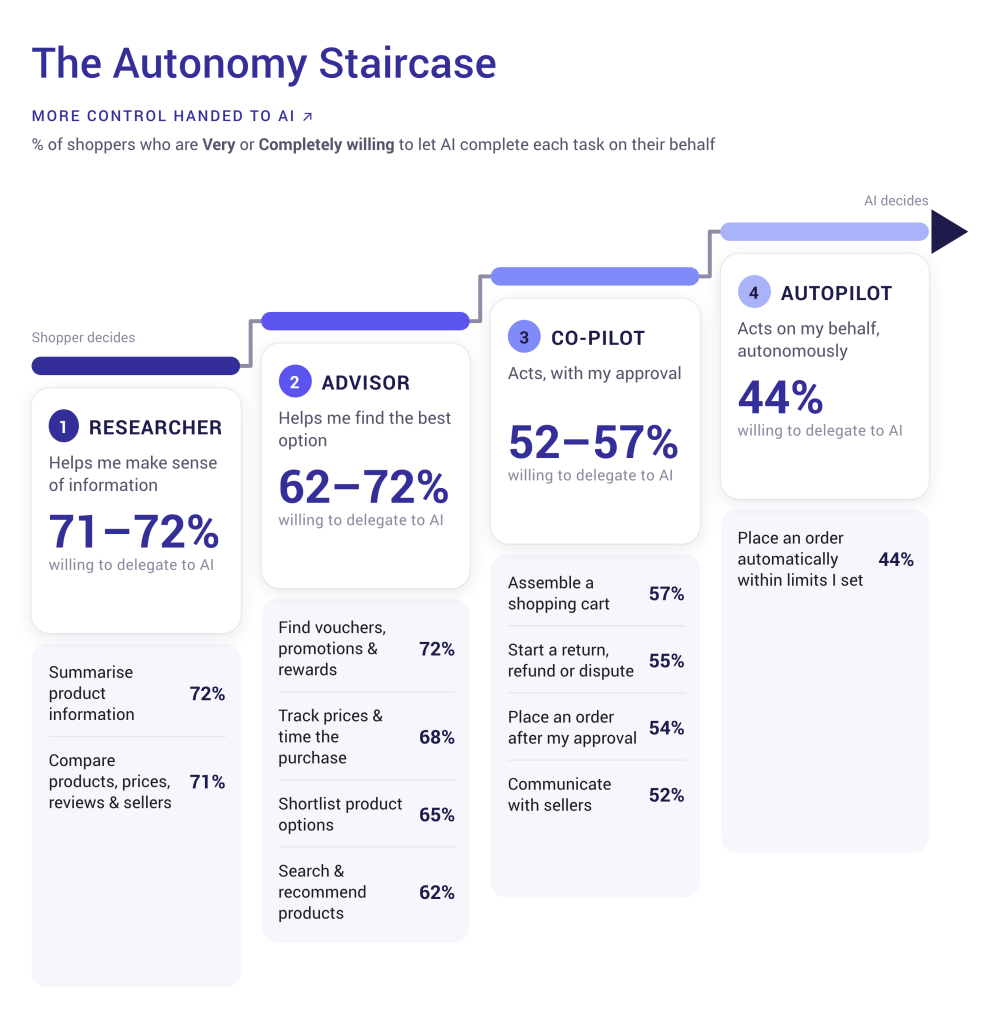
The Autonomy Staircase: The higher AI climbs, the fewer shoppers follow
To see how far shoppers would let AI go, we asked how willing they would be to let AI complete each shopping task on their behalf, if a tool existed to do so, focusing on those who were very or completely willing.
On the first two steps, as Researcher and Advisor, AI is welcomed. Around seven in ten shoppers would let it summarise product information, compare options or find vouchers and deals, the kind of legwork behind Verification and Value Optimisation. Once AI starts to act, willingness slips. As a Co-pilot, acting with the shopper’s approval, it wins over 52–57% of shoppers. On Autopilot, placing orders automatically within limits shoppers set, that falls to 44%. The biggest drop comes not at the very top, but at the moment AI stops advising and starts acting.
The steps shoppers welcome most, where AI acts as Researcher and Advisor, are already playing out in practice. On Lazada, AI Lazzie helps shoppers discover and compare products, while AI review summaries condense customer feedback into quick overviews. And these steps already carry real commercial weight: during Lazada’s 9.9 campaign in September 2026, AI-engaged shoppers spent 2.1 times more per order on average than non-AI shoppers. This does not show that AI caused the higher spending, but it points to the commercial value of AI that supports decisions, well before shoppers are ready to hand those decisions over.
Trust works both ways: The AI shoppers don’t control
So far, the staircase has covered AI that works for shoppers. But shoppers increasingly encounter AI that works for sellers and platforms too, generating product images, writing listings and answering customer questions. Shoppers don’t choose this AI, yet it draws on the same trust, and that trust is already being tested.
When asked how platforms or sellers could make online shopping more trustworthy, some shoppers raised AI unprompted, asking for real product photos rather than AI-generated ones, and a real person rather than a chatbot when an order goes wrong. These views come from a minority, but they point to a real risk for savvy shopping. AI-generated images and listings make it harder to check what a product is really like, undermining Verification, while chatbots that stand between shoppers and a real person make it harder to get help when something goes wrong, weakening Confidence & Protection. Even the most careful checks count for little if the information and support behind them can’t be trusted. As AI takes on a bigger role, trusted commerce environments, with verified sellers, authentic products and clear recourse, will only become more important.
Climb with shoppers, not ahead of them: What this means for platforms, brands and sellers
Our findings suggest the nearer-term opportunity lies lower down the staircase, in the research and advice tasks shoppers already welcome, the same legwork that sets Savvy Shoppers apart. Getting these steps right earns AI’s way up the staircase: each time AI helps a shopper verify, compare or choose well, it builds the trust the next step requires. For platforms, brands and sellers, that means racing to the top may not be the most pressing priority. Instead, they can lean into the AI features shoppers already use and trust, from review summaries to price comparisons, making these steps easier, faster and more reliable. From there, two priorities stand out.
Let autonomy grow with trust. Shoppers hesitate as AI moves closer to the purchase, but that hesitation isn’t set in stone: simply asking for approval first lifts willingness to let AI place an order from 44% to 54%. For platforms building shopping assistants, that points to adding autonomy in stages. Shoppers should be able to understand what AI is doing on their behalf, keep control over important actions through spending caps or approved sellers and brands, and step in or reverse an action whenever they need to. As AI demonstrates greater reliability and transparency, shoppers may become more comfortable delegating more.
Keep the real product, and real people, within reach. For brands and sellers, that means showing real photos alongside any AI-generated ones and making sure what arrives matches what was shown. The same applies to customer service. AI works best as a first line for standard inquiries, while more complex issues are best left in human hands.
Looking ahead, shoppers’ appetite to delegate is likely to grow as AI matures. For now, though, most are happy to let AI do the homework, but far fewer are ready to hand it the wallet. Brands and platforms that get that homework right, helping every shopper decide with confidence, will be best placed when shoppers are ready for the higher steps of the autonomy staircase.