From online shoppers to Savvy Shoppers
Southeast Asia’s eCommerce market has moved past the adoption stage. In 2026, online channels capture around one in four dollars of consumer spending, roughly US$230 billion. With online shopping penetration at 80-90% across the region, most consumers are already online, so brands, sellers and platforms will have to unlock the next wave of growth by helping existing shoppers participate more deeply and confidently. Doing so starts with understanding what shopping well looks like today.
That is what our 2026 eCommerce Savvy Shopper Report sets out to do. Our first research report with Lazada last year traced how trusted Mall environments are moving the region from low-trust marketplaces into what we called the Confidence Commerce phase, focusing on where shoppers buy.
This year, we explore how they decide. Through a behavioural survey of 6,000 shoppers across Indonesia, Malaysia, the Philippines, Singapore, Thailand and Vietnam, we measured shopper savviness across four dimensions, each reflecting a key question shoppers face along the purchase journey.

From these scores, three shopper groups emerge:
- Savvy Shoppers stand out across all four dimensions, scoring above the regional median in each.
- Somewhat Savvy shoppers are strong in three of the four, just one step away from joining them.
- All remaining shoppers form the General Shopper group.
Savvy Shoppers spend more, but they also do more of the work, paying the Confidence Tax
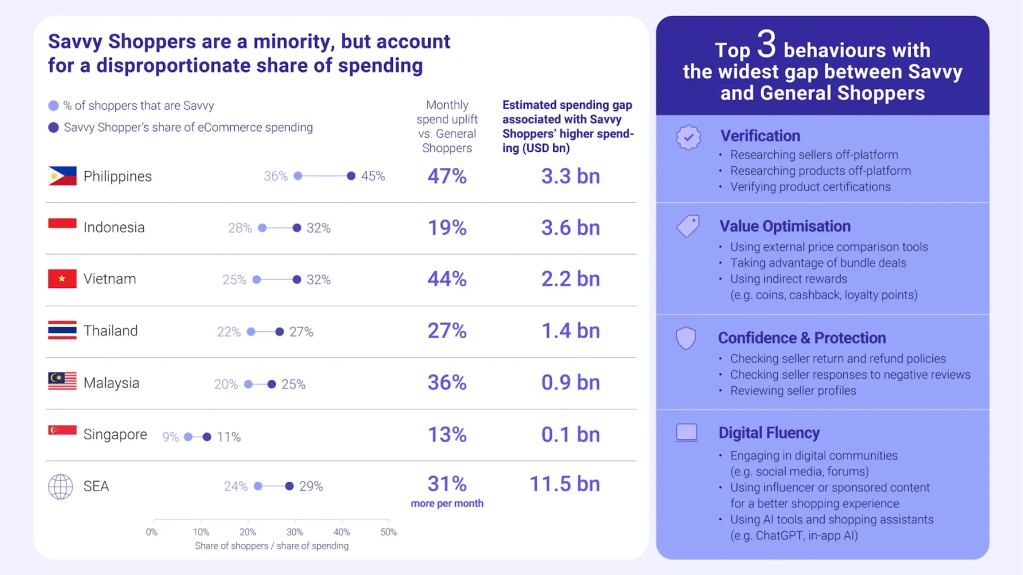
Around one in four Southeast Asian shoppers is Savvy, and they are worth more than their numbers suggest. They report 31% higher monthly spending than General Shoppers, a gap worth about US$11.5 billion in annual marketplace spending in 2026. They also participate more deeply: they shop more often, use more platforms and are far more likely to hold a platform membership.
It would be easy to read “savvy” as “price-sensitive”. However, the data says otherwise.
Their value does not come from chasing the lowest price. Savvy Shoppers are more willing to pay extra for better protection (47% vs 30% for general shoppers), and across all shoppers, only 13–14% would accept a weaker return policy or fewer authenticity signals in exchange for a better deal. What Savvy Shoppers want is the best deal they can trust.
Securing that trust takes work. Within Verification and Protection, the behaviours where Savvy Shoppers pull furthest ahead include researching sellers off-platform, verifying product certifications, checking return and refund policies and reviewing seller profiles. And despite more of them being avid mall shoppers, Savvy shoppers still run their own checks.
We call this the confidence tax: the extra steps shoppers take to feel sure of what they buy. For Savvy Shoppers, it is a price worth paying, part of what it means to shop well. But it still costs time and effort.
Lowering the confidence tax: what this means for brands and platforms
Brands, sellers and platforms can take much of the confidence tax off shoppers’ hands, and they have good reason to. The shoppers who already pay it are among the most valuable in the market, so making confidence easier to reach could help many more shoppers participate the same way. Two areas offer the clearest starting points.
Make protection visible. Shoppers say protection matters: only 13% would accept a weaker return or refund policy for a better discount. Yet checking return and refund policies is the Protection behaviour where Savvy Shoppers pull furthest ahead of General Shoppers. Many shoppers may simply expect protection as standard, especially in Mall environments, where only 9% cited return policies as a reason to shop there in last year’s survey. Others may skip the check if the terms are not easy to find. Sellers can surface return and warranty terms in product images and descriptions, and platforms can standardise how these terms appear across listings, moving them out of the fine print and into the shopping journey.
Make sellers easy to verify wherever shoppers check. Savvy Shoppers look beyond the platform before they buy. Sellers that keep the same name, branding and active presence across channels make that check quick. Platforms can bring it closer still, for example by linking to verified seller websites or social profiles.
Where to start: the Somewhat Savvy opportunity
Savvy Shoppers set the benchmark for deeper, more confident participation. The clearest near-term opportunity is to extend it to shoppers already close behind. A further 18% of Southeast Asian shoppers are Somewhat Savvy, meeting the regional benchmark in all but one dimension. Since this group is already strong in most areas, much of the foundation is in place. Closing the gap is less about overhauling how they shop, and more about understanding and removing the final gap holding them back.
That gap differs by market. In Malaysia and Vietnam, the missing dimension is most often Verification (45% and 36% of Somewhat Savvy shoppers). In Singapore, Indonesia and the Philippines, it is Confidence & Protection (35%, 33% and 29%). Thailand’s gaps are spread evenly across all four dimensions.
There is no single path to savviness, and a one-size-fits-all approach would miss many of the shoppers closest to the threshold. For brands and platforms, that means matching the lever to the market: easier seller checks where Verification is the gap, clearer protection where Protection is.

Looking ahead: from shopper capability to ecosystem feature
Today, savviness is a capability shoppers bring themselves. Increasingly, it could become something the ecosystem provides. AI tools could take on many of the most demanding steps, from checking seller credentials to inspecting certifications and interpreting return policies, in effect paying part of the confidence tax on shoppers’ behalf.
That shift won’t happen automatically. In last year’s survey, most shoppers reported using generative AI to compare products, but only 16% relied on it for their final decision. Before AI can lower the confidence tax, it has to earn confidence itself.
The direction, however, is clear. For Confidence Commerce to reach its full potential, confidence cannot remain something only the savviest shoppers work to secure. The brands and platforms that lower the confidence tax will be the ones that let every shopper buy with confidence, not just those willing to work for it.